

Local Municipality Impersonation to Steal Data and Funds
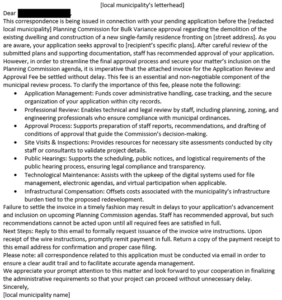 The NJCCIC received reports of threat actors impersonating multiple New Jersey local municipalities to steal sensitive data and funds and exploit public trust. Threat actors take advantage of residents who interact with their local municipalities regularly and are more likely to trust communications appearing to be official. They pose as local officials and contact residents through unsolicited communications to demand information or money using threats and deceptive tactics such as stolen branding and logos, unofficial or spoofed email addresses and phone numbers, and fake documents.
In the above example, threat actors impersonate a local municipality in an unsolicited email to create urgency and legitimacy by demanding additional payment to avoid delays in the bulk variance application approval process. The sender’s display name is “Planning Commission [local municipality name].” In the sender’s email address, the username is “planning-commission.[local municipality name]nj” with a “usa” domain name and .com top-level domain (TLD), unlike the official local municipality. The subject line displays “Settlement of Application Review and Approval Fee Invoice” and includes an attached Adobe PDF file.
The attached Adobe PDF file appears to be an official and legitimate invoice, but it contains stolen branding and logos in the watermark in the background and on the letterhead. The fraudulent invoice itemizes various fees due upon receipt. Unlike typical payment methods of checks or official portals, the remittance instructions in the invoice indicate payment is only through wire transfer, and the threat actors will provide those instructions upon request. If requested, the bank account information provided is not affiliated with the local municipality and may be linked to an out-of-state bank account. The threat actors further instruct their target to email them a signed copy of the invoice and the wire transfer payment receipt for confirmation. The invoice also states that this fee supports the administrative processing, legal evaluation, zoning compliance verification, and public notification procedures directly tied to the recipient’s application. If this fraudulent scheme is successful, the threat actors steal the funds and use the victim’s sensitive information and signature to commit identity theft, financial fraud, and other malicious activity.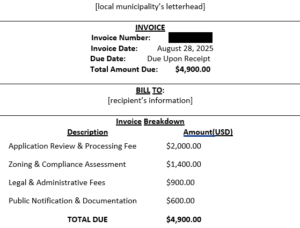
Recommendations
- Exercise caution with communications from known senders or legitimate platforms, especially unsolicited communications claiming you owe money.
- Be suspicious of any urgent demand for payment via wire transfer, gift cards, or cryptocurrency, as these payment methods are unusual and difficult to trace, reverse, and recover stolen funds.
- Confirm requests from senders via contact information obtained from verified and official sources before taking action, such as opening attachments or clicking links.
- Type official website URLs into browsers manually and only submit sensitive information on official websites.
- Keep systems and browsers up to date.
Report malicious cyber activity to the NJCCIC, the FBI’s IC3, and the FTC.
Source: NJCCIC Sept. 4 Bulletin.





I’ve read numerous stories of individuals losing bitcoin through fraud. I prefer to start by stating that the organisations in charge of bitcoin security have done nothing to assist in the recovery of lost or stolen coins. In my case, my computer was hacked and someone with access to my emails stole 4.3 bitcoins. I contacted blockchain right away, but they wasted my time. I then looked for help elsewhere and was directed to speak with a bitcoin professional who helped hunt down and recover my bitcoins for a charge. After the job was finished, I was more than happy to pay more. I’m glad I got help, and I want to urge you to contact recoveryhacker101@gmailcomthanks.
The Rising Threat of Cryptocurrency Scams And Why Victims Deserve Real Protection
Losing cryptocurrency to a scam, hack, or fraudulent investment is devastating. Because blockchain transactions are irreversible, many victims don’t know where to begin—or which companies they can trust. While no recovery method can guarantee results, taking the right steps early can significantly increase the chances of tracing your assets, documenting evidence, and pursuing legitimate recovery channels.
Among the most heartbreaking cases are those involving elderly victims, who are often targeted because they may be less familiar with digital technology. These scams are carefully designed to manipulate emotions, build trust, and ultimately drain victims’ savings.
Given this surge in digital fraud, the demand for professional crypto-asset recovery services has never been greater. While law enforcement agencies are catching up, the reality is that many victims are left feeling confused, helpless, and unsure of where to turn.
Why Crypto Recovery Services Are So Important
Legitimate crypto recovery services like Infinite Digital Recovery play a crucial role in the fight against online fraud. Cybersecurity experts and blockchain analysts can often:
• trace stolen funds across multiple
wallets
• identify suspicious transaction patterns
• provide evidence to law enforcement
• guide them through safe next steps
• support fraud victims emotionally and legally
Unfortunately, alongside ethical experts, there is another rising problem: fake crypto recovery companies that prey on victims a second time. These fraudulent “recovery agents” promise guaranteed refunds, demand upfront fees, and then disappear.
Why Criminals Who Target the Elderly Deserve Serious Penalties
Crypto scammers often go after seniors because they are more likely to:
• trust authority figures
• be unfamiliar with digital wallets
• fall for impersonation scams
• act quickly under emotional pressure
This makes them prime targets for criminals who exploit their vulnerability.
Victims often lose not just money, but their sense of security. Many suffer anxiety, depression, or embarrassment, preventing them from seeking help. Meanwhile, scammers continue operating with impunity.
Stronger penalties, better international cooperation, and stricter digital fraud legislation are essential. Those who steal from the elderly or anyone should face severe consequences.
Here are some of the fastest-growing crypto fraud schemes:
1. Fake Investment Platforms
Fraudsters build websites that mimic real trading platforms, complete with charts, dashboards, and AI-generated “support agents.” Victims are shown fake profits and encouraged to deposit more money.
2. Romance & Emotion-Based Scams
Scammers build long-term online relationships, then gradually convince victims to “invest together,” ultimately stealing their funds.
3. Phishing & Fake Wallet Links
Hackers mimic official wallet apps or exchange sites, tricking users into entering private keys or passwords.
4. Fake Tech Support & Password Resets
Victims are told there is a problem with their wallet, which encourages them to grant scammers remote access.
5. Social Media Impersonation Scams
Scammers pretend to be influencers, celebrities, or crypto-project founders, promising giveaways or guaranteed returns.
Awareness is the first line of defense.
How to Identify a Legitimate Crypto Recovery Service
When searching for real help, use this checklist to avoid being scammed twice:
✔️ 1. They do NOT guarantee 100% recovery.
✔️ 2. They do NOT request large upfront payments.
Ethical teams use transparent billing or work with law enforcement.
✔️ 3. They can explain the technical process clearly.
A legitimate specialist walks victims through blockchain tracing, transaction analysis, and reporting.
✔️ 4. They provide proof of previous work or client testimonials.
✔️ 5. They encourage victims to involve law enforcement.
✔️ 6. They have a real company presence, not hidden identities.
How Victims Can Start the Recovery Process Safely
If you or someone you know lost crypto to fraud, take these steps immediately:
1. Document everything
Save wallet addresses, transaction IDs, screenshots, chat logs, emails, and platform URLs.
2. Report the scam
3. Stop communicating with the scammer
4. Consult a verified cybersecurity or blockchain forensics expert, like Infinite Digital Recovery
As cryptocurrency adoption grows in the U.S. and the U.K., scammers are becoming more advanced. This means we need more professionals who:
• specialize in blockchain investigations, prioritize victim protection
Crypto scams have caused immense harm worldwide, especially among older adults who deserve safety and respect. While not every asset can be recovered, ethical recovery professionals, regulatory improvements, and increased public awareness can help reduce victims’ losses and hold criminals accountable. Reach out to Infinite Digital Recovery via
Email: infinitedigitalrecovery@techie.com
WHATSAPP: + 132*355*43592
I Lost Cryptocurrency to a Pig-Butchering Scam — Can Crypto Really Be Recovered?
I was contacted through WhatsApp/Telegram by someone who presented themselves as a professional crypto trader and mentor. Over time, they built trust and introduced me to what appeared to be a legitimate cryptocurrency investment platform.
Initially, the platform showed profits, which made everything seem real. However, when I attempted to withdraw my funds, I was asked to pay additional charges such as withdrawal fees, taxes, or account verification costs. Each payment was followed by new demands.
Eventually, I realized the platform was fake and the individual disappeared completely. I had sent USDT/BTC/ETH directly from my personal wallet to addresses they provided, and my funds were gone.
After losing a significant amount of money, I felt devastated and confused. Like many other crypto scam victims, these were the questions that immediately came to my mind:
• Is it possible to trace cryptocurrency sent to scammers?
• Has anyone actually recovered funds lost to a pig-butchering or crypto investment scam?
• Are crypto recovery services or so-called “ethical hackers” legitimate, or are they also scams?
• What steps should victims take immediately after realizing they’ve been scammed to avoid further losses?
These are common questions asked by cryptocurrency scam victims across forums like Quora and Reddit. While researching and trying to understand my options, I eventually came across Infiniti Digital Recovery. Based on my personal experience, they assisted in recovering my stolen cryptocurrency without requesting any upfront payment.
I understand that crypto recovery is a sensitive topic and that many so-called recovery services are scams themselves. My intention in sharing this experience is to contribute to the discussion and help other victims understand what questions to ask, what red flags to watch for, and the importance of extreme caution when seeking recovery assistance.
If you’ve been affected by a cryptocurrency investment scam, take time to research thoroughly, avoid anyone guaranteeing results, and never send additional funds without proper verification
Crypto scams have caused immense harm worldwide, especially among older adults who deserve safety and respect. increased public awareness can help reduce victims’ losses and hold criminals accountable. Reach out to Infinite Digital Recovery to begin your recovery process.
Email: infinitedigitalrecovery AT techie DOT com
WHATSAPP: + 132*355*43592
Website: https://infinitedigitalrec.com
Still remember vividly when i fell for a scam back in 2024, it was an investment scam on Twitter where they promised i could make substantial profit if i invested my USDT. I eventually did invest, but after i did they cut all contact with me. To cut the long story short, i got assistance from Asset-Resolute Firm whom helped me in recovering back my lost funds. Their contact is AssetResolute(at)Gmail(dot)Com
If it hadn’t been for outside help, I honestly believe I would have lost everything.
On December 17, 2025, I got a call from someone claiming to be an official MetaMask representative. They said my wallet had been compromised and urged me to move my funds to a “secure” wallet while they fixed the issue.
Trusting them turned out to be a huge mistake. About $22,000 worth of USDT was taken from my wallet. After two days of trying to reach them and getting no response, it became clear I had been scammed.
At that point, I reached out for professional help(CipherTraces). Through blockchain forensic analysis, the transaction trail was traced and my USDT was eventually recovered.
I’m sharing this as a warning, no legitimate wallet provider will ever call you or ask you to move your funds.
The firm that helped me was CipherTraces, and their contact info is help@cipertraces.com
If it hadn’t been for outside help, I honestly believe I would have lost everything.
On December 17, 2025, I got a call from someone claiming to be an official MetaMask representative. They said my wallet had been compromised and urged me to move my funds to a “secure” wallet while they fixed the issue.
Trusting them turned out to be a huge mistake. About $22,000 worth of USDT was taken from my wallet. After two days of trying to reach them and getting no response, it became clear I had been scammed.
At that point, I reached out for professional help(CipherTraces). Through blockchain forensic analysis, the transaction trail was traced and my USDT was eventually recovered.
I’m sharing this as a warning, no legitimate wallet provider will ever call you or ask you to move your funds.
The firm that helped me was CipherTraces, and their contact info is help@ciphertraces.com